A number of countries around the world have now ditched almost all Covid rules despite dealing with a surge in case numbers during the Omicron wave.
The move contrasts with Australia and some other nations where governments are only slowly rolling back Covid-19 restrictions in the face of the variant.
This week Denmark became the first European country to discard nearly all of its Covid-19 restrictions despite case numbers still rising due to Omicron and its new sub-variant, BA.2.
Ireland, France and the Netherlands are expected to follow Denmark’s lead in coming weeks, with only restrictions on unvaccinated travellers and the wearing of face marks in hospitals and aged care homes remaining.
England is holding onto some rules, including masks on public transport in London, but has done away with many other restrictions, including work-from-home recommendations and limits on visitor numbers in hospitals and aged care.
Other countries still dealing with a surge in Omicron-related cases, such as Singapore and Japan, retain relatively strict rules around social distancing and bans on unvaccinated people in public venues such as cafes and restaurants.
State of emergency measures currently apply in 37 of Japan’s 47 prefectures until at least February 20.
In relative terms, Australia falls somewhere in the middle when it comes to ongoing domestic Covid-19 restrictions.
Below is how we compare with some other nations around the world.

A customer exits a supermarket in Copenhagen, Denmark. The Danish government has lifted Covid restrictions, saying COvid-19 is no longer a ‘socially critical disease’
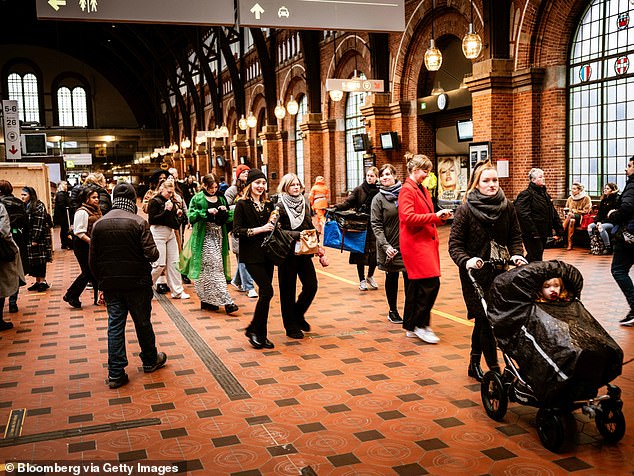
Commuters are seen at the Central railway station in Copenhagen, Denmark, after most Covid restrictions in the country had been ditched, despite rising case numbers
Denmark
The Scandinavian country has lifted its domestic Covid-19 restrictions after its government said Covid-19 is no longer a ‘socially critical disease’.
The wearing of face masks is no longer required in shops, restaurants, and on public transport.
In other changes, nightclubs were reopened, late-night alcohol sales permitted and checking in app to enter venues was dropped.
Limits on the number of people allowed at indoor gatherings and social distancing measures have also ended.
Unvaccinated travellers from outside Denmark’s free travel zone are still restricted, and face masks must continue to be worn in hospitals and care homes.
More than 80 per cent of Denmark’s population over five years of age have now received two vaccinations and more 60 per cent had received a third booster dose.
The dropping of restrictions comes despite the county recording a five-day average of 43,309 new Covid cases due to Omicron.
Denmark was down to fewer than 5,000 cases a day as recently as early December.
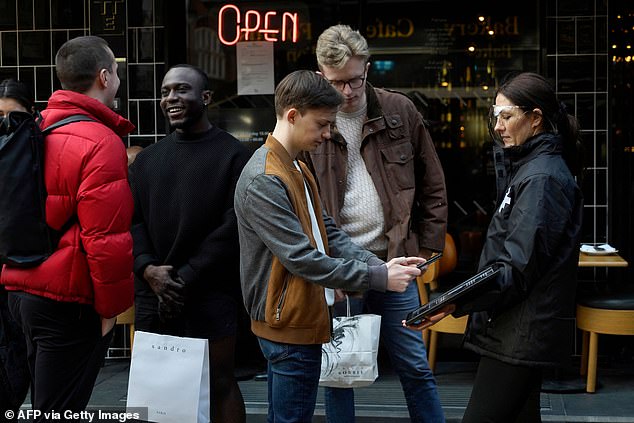
A customer uses their phone to scan a QR code for the NHS Test and Trace in Soho, London. England has now rolled back the need for Covid ‘passports’ under the recently announced relation of Covid rules
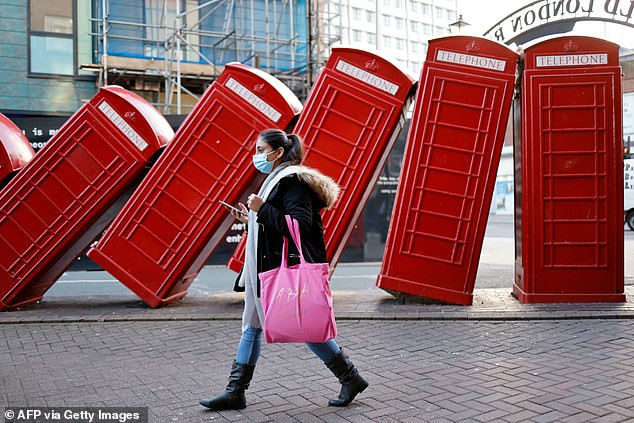
A shopper in a face mask walks in Kingston-upon-Thames in south-west London. Mandatory masks are no longer required in public places in England
England
England ended its ‘Plan B’ measures in January, with Prime Minister Boris Johnson announcing the Omicron wave had peaked in the country.
As of February 1, however, England continued to see Covid cases rise, with a seven-day average of 186.602 cases.
Mandatory face coverings in public places and Covid passports have both been rolled back, and official advice that people try and work from home has ended.
Restrictions remaining in England including the need for people who develop Covid symptoms or test positive to self-isolate for 10 days (or five full days following two negative DIY lateral flow test results). It’s currently seven days in Australia.
It’s now optional for venues to ask people to demonstrate their vaccine status through the NHS Covid Pass, while retail outlets retain the discretion to ask customers to wear face masks.
Masks remain mandatory in health and care settings, including hospitals, GP surgeries and pharmacies, and on public transport in London. Some local authorities have also insisted on masks in the communal areas of schools.
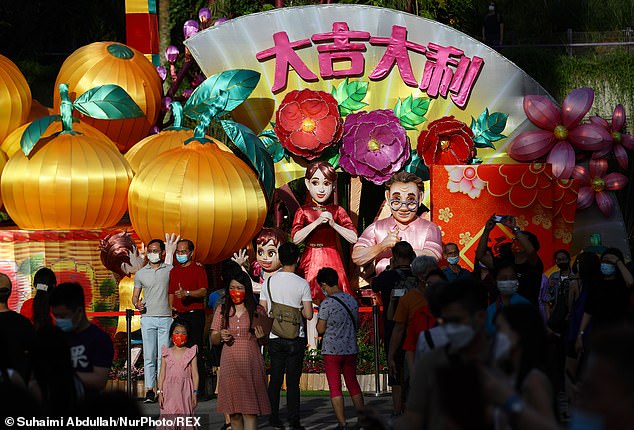
The island nation of Singapore continues with strict density limits and restrictions on the unvaccinated as cases spike due to Omicron
Singapore
The island nation retains more onerous restrictions than Australia as it experiences a five-day average of over 5,000 cases a day due to Omicron.
Singapore’s Ministry of Health is still predicting a peak of up to 10,000-15,000 new cases a day in February.
Like Queensland and Victoria, Singapore maintains strict conditions on the movement of unvaccinated people, restricting them from restaurants, cafes and other entertainment venues.
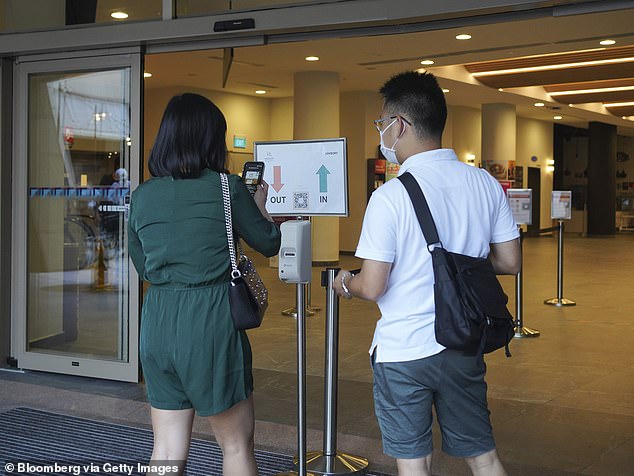
A shopper scans a QR code with a phone at a mall in Singapore. A density limit of one person per 10 square metres applies in shopping malls and large retail stores
Even for fully vaccinated people, limits on gatherings continue.
Group sizes of up to five people only are permitted in food and beverage outlets, social gatherings and outdoor activities, but up to 1,000 people fully vaccinated people can attend live performances and sporting events.
Up to five unique visitors a day are permitted to visit households, while a density limit of one person per 10 square metres applies in shopping malls and large retail stores.
Only 50 per cent of the workforce who were able to work from home are permitted to return to the workplace, provided they are fully vaccinated.
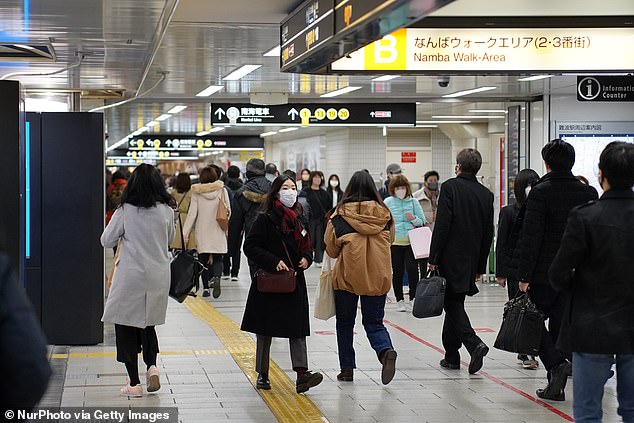
People wearing face masks inside Namba station in Osaka, Japan on January 27. State of Emergency measures are in place in the majority of Japan’s prefectures
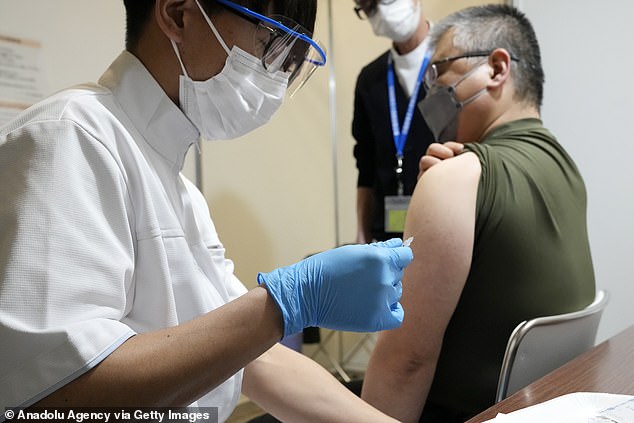
A man receives a third dose of a Covid-19 vaccine in Japan during the nation’s current Omicron surge
Japan
One of the earliest countries to experience significant Covid cases in 2020 recently passed 60,000 new cases a day for the first time in the pandemic and continues to see a sharp spike in new infections.
On February 1 Japan recorded more than 81,500 new cases in a day.
As a result the country has closed its border to international arrivals until at least the end of February 2022.
Despite state-of-emergency measures remaining in 37 of Japan’s 47 prefectures, including Hokkaido, Kyoto, Osaka, Okinawa and Hiroshima, until at least February 20, life has mostly returned to normal in the country.
The south-western regions of Okinawa, Yamaguchi and Hiroshima recently announced earlier closing hours for restaurants, a ban on serving alcohol and restrictions on large-scale events.
Mask-wearing remains mandatory in most public places, including on public transport.
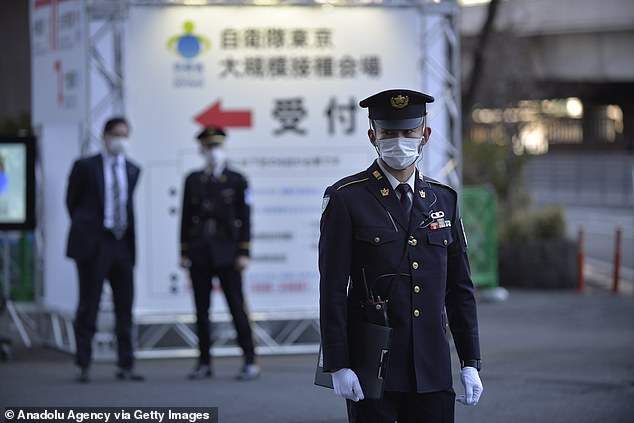
Security is seen at the entrance of a large-scale vaccination site in Tokyo, Japan. On February 1 Japan recorded more than 81,500 new cases in a day
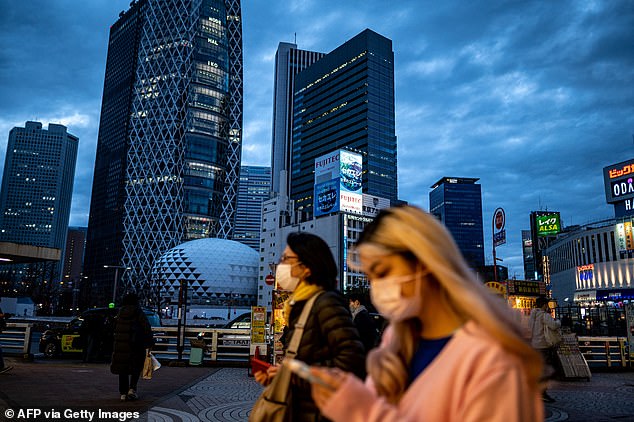
Pedestrians walk in the Shinjuku district of Tokyo as the city and a number of regions across the country earlier this month were placed under partial Covid-19 restrictions
Most sports and entertainment venues retain a 50 per cent capacity limit and certain parts of the country still mandate social distancing protocols.
QR codes and checking of vaccination status are no longer used but many retail outlets, restaurants and other venues employ temperature checks for entry.
A number of tourist attractions across the country have closed as local case numbers grow.
Japan’s health ministry recently announced younger people considered ‘low risk’ could self-administer rapid antigen tests and isolate at home without waiting for a doctor’s diagnosis.
Previously, patients had to be registered as a Covid-19 patient by a doctor.
Source link